- Home
- Running Training Plans
- Couch to 10k
Couch to 10k: Your flexible 12-week run–walk plan
By Andrew Greenhalgh Revised September 2026
The Couch to 10k program starts with run-walk intervals – 1 minute running followed by 2 minutes walking x8. If you’re wondering whether you could ever run 10k, you’re in the right place. I’ll guide you from those first short runs towards longer sessions, with practical advice and encouragement to help you find your feet and keep going.
This
3-days-a-week
program
helps you work towards completing 10k in manageable steps. You might
want to run the whole distance without stopping, or prefer a more
relaxed run–walk approach. Both are welcome here, with room to
repeat sessions and progress at a pace that suits you.
Here
you’ll find:
- Your starting point — begin with what you can manage today.
- A 12-week schedule — short run–walk sessions that build towards your first 10k.
- Keep going through setbacks — practical advice for missed runs, recovery and knowing when to repeat a week.
- Support beyond running — motivation, strength and nutrition.
- Your route to the finish — a printable program and a Week 11 check to help you prepare for your first 10k.
Over the years, readers who followed this schedule have written to tell me they reached 10k when they never imagined they could. Returning runners have told me it helped them build back towards the distance after a time away from running.
Wherever you’re starting from, let’s take the first step and see where it leads.
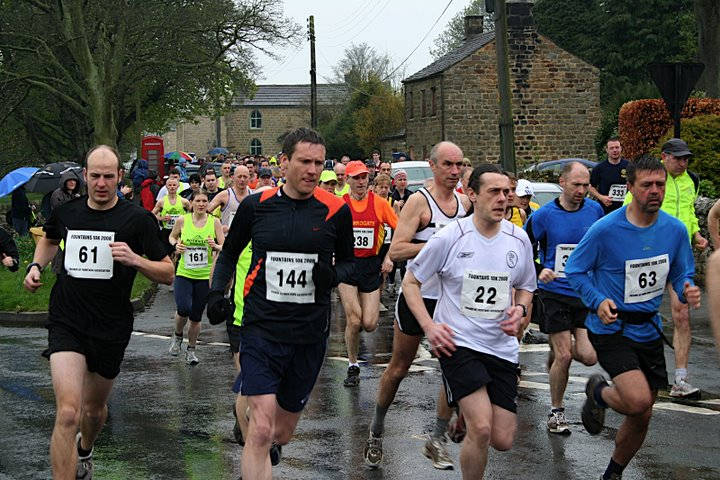
Before you start Couch to 10K
Whether you’re new to running or returning after a break, I suggest you feel comfortable walking for about an hour before you start. This is a practical readiness guide, not a medical fitness test. Your longest session in Week 1 takes 40 minutes, including running intervals and all the walking breaks. If that sounds like too much at present, start by building up your walking.
If 10k feels too far away just now, you can begin with my Couch to 5k plan. If you already run about 2 miles comfortably, the separate beginner 10k training plan starts from that stronger base.
I followed a Couch to 5k run–walk program in 2006 and have returned to run–walk intervals many times to rebuild fitness after injury. Four marathons later, walking still has a place in my running, especially on long cross-country routes and the steep climbs around Lee Quarry. If you’re coming back after a break, draw confidence from what you’ve done before, but let your current fitness set the starting point.
If you have an unresolved injury, or a health condition or symptoms that make you unsure about starting, get appropriate advice first. A general beginner schedule cannot replace an individual return-to-running plan. [1]
How to use your Couch to 10k plan
Choose three days with a non-running day between them. Monday, Wednesday and Saturday would work, but choose days that fit your life. The second session is usually shorter, and the third is generally the longest. The NHS beginner program also uses three weekly runs with rest days between them. Its timetable is for Couch to 5k; the Couch to 10k schedule here is my own design. [1]
Find a comfortable running pace. You should be able to speak a short sentence without gasping. If you can’t, ease off or take a walking break. For now, focus on finishing each session with something left in the tank.
Start and finish with a walk. Walk for five minutes before you begin the running intervals and for another five minutes after you finish. The session times in the tables include both walks.
“Run 1 min / walk 2 min × 8” means alternating 1 minute of running with 2 minutes of walking, repeated 8 times. That’s 24 minutes, including the final walking interval, or 34 minutes with your 5-minute warm-up and cool-down walks.
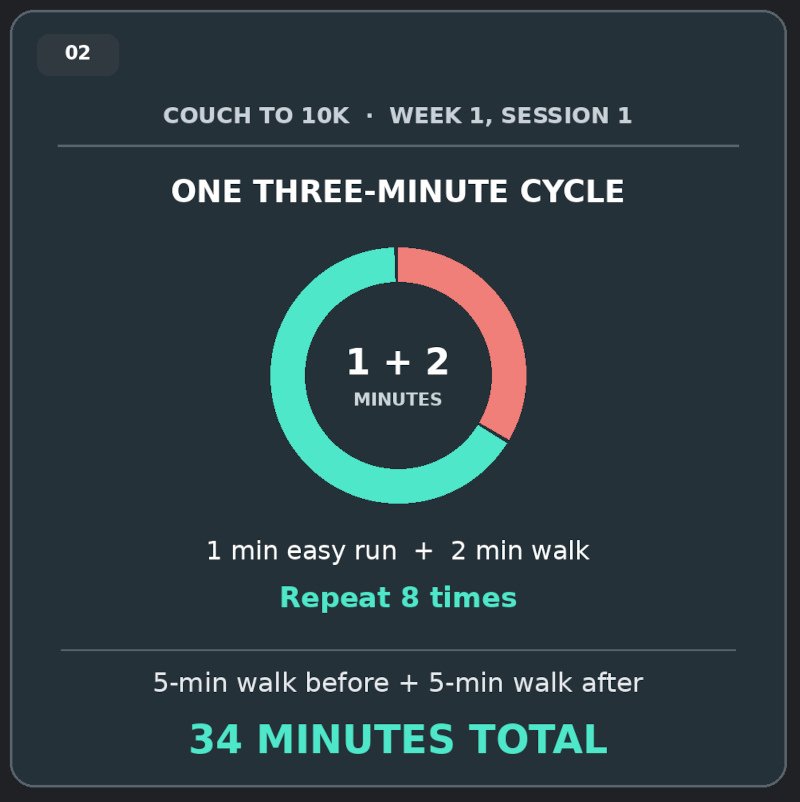
Couch to 10k schedule: Weeks 1–6
All running is at an easy effort. Totals include the five-minute walks before and after, plus every listed walking interval. “Session 1, 2 and 3” means three outings in a week, not consecutive days.
| Week | Session 1 | Session 2 | Session 3 |
|---|---|---|---|
| 1 | Run 1 min / walk 2 min × 8 tot = 34 min | Run 1 min / walk 2 min × 6 tot = 28 min | Run 1 min / walk 2 min × 10 tot = 40 min |
| 2 | Run 2 min / walk 2 min × 7 tot = 38 min | Run 2 min / walk 2 min × 6 tot = 34 min | Run 2 min / walk 2 min × 8 tot = 42 min |
| 3 | Run 3 min / walk 2 min × 6 tot = 40 min | Run 3 min / walk 2 min × 5 tot = 35 min | Run 3 min / walk 2 min × 7 tot = 45 min |
| 4 | Run 5 min / walk 3 min × 4 tot = 42 min | Run 5 min / walk 2 min × 3 tot = 31 min | Run 5 min / walk 3 min × 5 tot = 50 min |
| 5Easier week | Run 3 min / walk 2 min × 6 tot = 40 min | Run 3 min / walk 2 min × 5 tot = 35 min | Run 5 min / walk 3 min × 4 tot = 42 min |
| 6 | Run 8 min / walk 3 min × 3 tot = 43 min | Run 7 min / walk 2 min × 3 tot = 37 min | Run 8 min / walk 3 min × 3 tot = 43 min |
By the end of Week 6, those one-minute runs have grown into seven- or eight-minute stretches. Take a moment to recognise that progress before moving on.
Week 5 is deliberately easier. If the longer running blocks in Week 6 still feel demanding, repeat an earlier session or shorten the blocks to give yourself an intermediate step.
The next part builds towards longer continuous runs and your first 10k. Keep the effort comfortable and take walking breaks when you need them. You can work towards running the whole distance or choose to run–walk it.
Couch to 10k schedule: Weeks 7–12
You can take walking breaks at any stage of the plan. If a session says “Run 25 min,” aim for 25 minutes at an easy effort. You may run continuously or walk for part of that time. The walking break counts within the 25 minutes, so you don’t need to add extra time to make up for it. With the five-minute walks before and after, the outing takes 35 minutes in total.
| Week | Session 1 | Session 2 | Session 3 |
|---|---|---|---|
| 7 | Run 9 min / walk 3 min × 3 tot = 46 min | Run 8 min / walk 2 min × 3 tot = 40 min | Run 10 min / walk 3 min × 3 tot = 49 min |
| 8 | Run 15 min / walk 5 min × 2 tot = 50 min | Run 15 min / walk 5 min / run 10 min tot = 40 min | Run 20 min / walk 5 min / run 15 min tot = 50 min |
| 9Easier week | Run 10 min / walk 3 min / run 16 min tot = 39 min | Run 15 min / walk 5 min / run 10 min tot = 40 min | Run 15 min / walk 5 min × 2 tot = 50 min |
| 10 | Run 20 min / walk 2 min / run 20 min tot = 52 min | Run 25 min tot = 35 min | Run 40 min tot = 50 min |
| 11 | Run 45 min tot = 55 min | Run 25 min tot = 35 min | Run 50 min tot = 60 min Record your distance during the 50-minute run. |
| 12 | Run 40 min tot = 50 min | Run 30 min tot = 40 min | 10k event or your own measured 10k route |
Week 9 reduces the running demand before the longer sessions return. The final outing is 60 minutes of easy running and walking, plus the two five-minute walks. That may cover 10k, or it may fall short. The distance section below explains what to do next.
Download the printable Couch to 10k program (PDF)Adjusting the plan when life gets in the way
When a week feels too demanding
Return to the last session you could manage comfortably; the week before is usually best. If you repeatedly finish exhausted, struggle to complete the intervals, or are still unusually tired or sore when the next run comes round, ease back before increasing again.
Week 2 is a bigger step than it may seem at first. Your total running time rises from 24 to 42 minutes across the three sessions, and each running interval doubles in length. If that feels too demanding, repeat Week 1 or try fewer repeats in Week 2 before completing the full sessions. The NHS program also allows you to repeat sessions or weeks. [1]
Research has not established a weekly percentage increase that guarantees injury-free running. In one trial, beginners following a gradual program based on the “10% rule” had no fewer injuries than those following a shorter program. A more recent study looked at individual runs rather than weekly totals. It found higher overuse injury rates when a run was more than 10% longer than the runner’s longest run in the previous 30 days. That does not mean smaller increases are always safe, or larger ones always cause injury. My advice is to avoid sudden jumps in distance and repeat a stage if you are struggling to recover. [2] [3]
When you miss a session or a week
Do the next manageable session when you can, keeping a non-running day between outings. After illness or a longer break, restart below your previous level and see how you respond. You don’t need to squeeze missed runs into the remaining days.
If you’re choosing a 10k event at the start of this 12-week program, look for one at least 14 weeks away. Those extra two weeks give you room to repeat a week or two if you need to, before following the final event week. An event date can be motivating, but there’s no need to rush to meet it. On event day, you can run–walk the 10k instead of running it all. If you’re not ready to cover the distance, you could enter a shorter race or move your Couch to 10k target to a later date.
When something hurts
Stop running if you have sudden, sharp, or worsening pain, or pain that changes your stride. Seek advice for persistent or recurring symptoms. After an injury, severe or worsening pain, substantial swelling, or being unable to bear weight or walk more than a few steps needs prompt assessment; in the UK, NHS 111 can advise. [4]
Some muscle soreness can follow unfamiliar exercise, but being able to push through pain does not mean it is harmless. My running injuries guide explains when to seek help and how to think about returning.
Your Week 11 distance check
During the 50-minute run in Week 11, use a phone app or GPS watch to record what distance you cover. Keep your usual easy effort; this is a distance check, not a speed test. Measure the 50-minute session separately from the five-minute walks before and after. Your average pace, including any walking breaks within the session, gives you a rough estimate of how long 10k may take. These examples show how pace affects the time needed:
| Average pace | Time to cover 10K |
|---|---|
| 6:00 min/km (9:39 min/mi) | 60 minutes |
| 7:00 min/km (11:16 min/mi) | 70 minutes |
| 8:00 min/km (12:52 min/mi) | 80 minutes |
| 9:00 min/km (14:29 min/mi) | 90 minutes |
Taking longer than an hour to finish your first 10k is fine—the goal is to cover the distance at a pace you can manage. Your Week 11 distance check helps you estimate how long that might take. Consider that estimate alongside how comfortable the run felt and how well you recovered. If 10k is likely to take much longer than you’ve run so far, use the extra weeks to build up your longest outing before the final event week. Keep your other two sessions at familiar lengths. You might add five to ten minutes to the longer session, but that is a suggestion, not a guaranteed safe increase. Add less, repeat the same duration or cut back if you need more recovery.
If you can comfortably run 4.5 miles (about 7.2km) in your Week 11 session and recover well afterwards, I’d see that as a reason to feel confident about your first 10k. You can save the full distance for race day, keep to your usual pace and take walking breaks if needed. There will still be another 1.7 miles to cover, so if the training run leaves you exhausted or unusually sore, allow more preparation time.
If you’re not entering an event, choose a measured 10k route and set your own date to complete it.
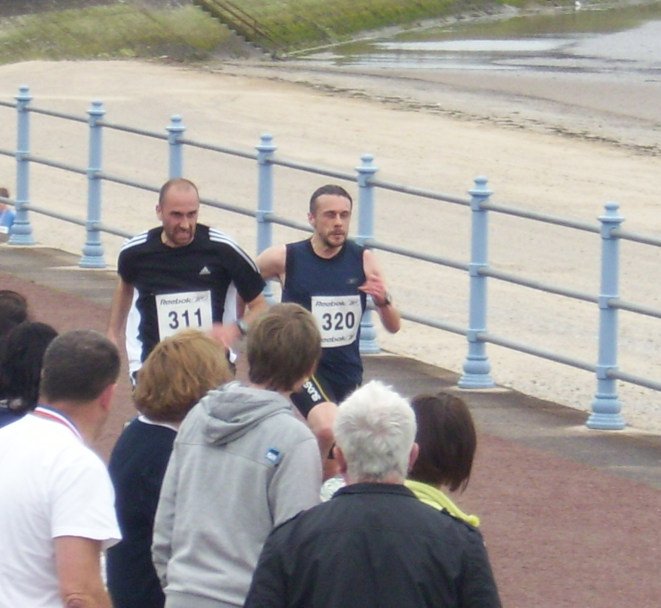
Keeping your motivation through Couch to 10k
An event gives you a date to work towards and something to look forward to. I love running events, and if you’re unsure about entering one, I’d encourage you to give it a try—they can feel far less daunting once you’re there. You may cross the finish line already thinking about your next one. If you’d rather complete a quiet route without a crowd or a number pinned to your vest, that counts just as much. Choose whichever will make your first 10k something you’re excited to work towards.
According to a review of motivation studies, people are more likely to keep exercising when they enjoy it and feel the goal is their own. The review did not test this Couch to 10k program or establish what will work for every runner. It does, though, give you a good reason to choose the 10k finish that appeals to you: an event with other people or a route you cover in your own time. [5]
You can make the training your own, too. Choose routes you like, invite someone along if you enjoy company, and notice more than the pace on your watch. “Finished with energy left” or “walked when I needed to” can tell you more about how a session went than your speed alone.
That is especially useful when you repeat a week. You may cover the same ground in the same time, yet the session may feel easier. That counts as progress too.

Support the running you are doing
Strength and recovery
I’ve combined running with strength work for years. For someone starting Couch to 10k, I would introduce it in manageable amounts and leave enough energy for the next outing. General NHS guidance recommends working the major muscle groups on at least two days a week; that amounts to a broader health recommendation, not a requirement to add two hard workouts immediately. [6]
As your running routine settles, make strength work a regular part of your week, focusing on your hips, core, thighs and calves. Research on injury prevention is mixed: a 2024 review found no clear overall reduction in running injuries, although supervised programs showed more promise. A separate trial found fewer injuries among novice runners following a physiotherapist-guided hip and core program. [7, 8]
Injury Management begins before a problem arises: make strength work part of your routine, learn how to perform the exercises and increase the challenge gradually. It’s a way to prepare for the demands of running, with time to adapt and recover. My strength training for runners guide will help you get started.
Start with a modest amount of strength work that you can manage alongside your runs. The same applies to other activities: an easy walk or cycle may fit a non-running day, but you don’t have to fill every gap with exercise. Before adding more, consider how well you’ve slept, how tiring your work has been and whether your current training is already leaving you sore or tired.
Runner’s Diet
You don’t need a special runner’s diet to begin. Eat enough to support your training and recovery, keep meals varied and choose foods you enjoy. Oats, rice, potatoes, fruit and vegetables, alongside protein sources and fats, provide a practical starting point. Convenience foods can fit too—what matters is how you eat overall. [9]
Before a run, choose something familiar that sits comfortably, such as porridge, and drink regularly throughout the day. If weight loss is also a goal, make sure you’re eating enough to support training and recovery as your running increases.Beyond Your First 10K
Completing Couch to 10K gives you something to build on. You might enjoy running this distance regularly, aim for a faster time or eventually try a longer event. Give yourself time to recover before taking on another challenge, and choose a goal that keeps running enjoyable and fits your life.
After your first 10k
Enjoy it before deciding what comes next. You can keep three outings a week, with two shorter sessions and a longer one when it suits you. There is no need to run 10k every time, or to enter a half marathon before the satisfaction of this distance has worn off.
You might choose to run more of the route continuously, enter another 10k and aim for a time (sub 1hr, e.g.), or make running part of an ordinary week. If you want help with the basics as you continue, visit Running for Beginners.
For now, choose a day for Week 1, Session 1 of the Couch to 10k schedule and take that all-important first step out of the door. 1 minute running, 2 minutes walking, repeated 8 times—that’s where it begins. In around three months, you could be looking back at today with your first 10k behind you.
— Andrew
Research used:
- NHS — Couch to 5k running plan. Rest days between three weekly runs, five-minute walks, repeatable sessions and health preparation. Used as guidance, not as validation of this 10k schedule. Read the NHS plan.
- Buist I and colleagues (2008). No effect of a graded training program on the number of running-related injuries in novice runners: a randomised controlled trial. American Journal of Sports Medicine, 36(1), 33–39. Read the study abstract.
- Frandsen JSB and colleagues (2025). How much running is too much? Identifying high-risk running sessions in a 5200-person cohort study. British Journal of Sports Medicine, 59, 1203–1210. Read the study abstract.
- NHS — Sprains and strains. Symptoms and circumstances requiring medical advice after injury. Read the guidance.
- Teixeira PJ and colleagues (2012). Exercise, physical activity, and self-determination theory: a systematic review. International Journal of Behavioural Nutrition and Physical Activity, 9, 78. Read the review.
- NHS — Physical activity guidelines for adults aged 19 to 64. General activity and strengthening guidance. Read the guidelines.
- Wu H and colleagues (2024). Do Exercise-Based Prevention Programs Reduce Injury in Endurance Runners? A Systematic Review and Meta-Analysis. Sports Medicine. Read the review.
- Leppänen M and colleagues (2024). Hip and core exercise program prevents running-related overuse injuries in adult novice recreational runners: a three-arm randomised controlled trial (Run RCT). British Journal of Sports Medicine, 58, 722–732. Read the study abstract.
- NHS — The Eatwell Guide. General balanced-diet guidance. Read the guide.
Recent Articles


-
Running for Beginners: Start Small, Build a Lasting Habit
Oct 06, 26 05:11 PM
 Explore running for beginners with practical run-walk advice, clear guidance and first-hand experience. Start at your own pace and build a lasting habit.
 -
Running Training Plans | From Beginner to Advanced
Oct 04, 26 05:00 PM
 Find running training plans for your first target, a faster 5k or 10k, or a half or full marathon—with advice to balance training, recovery and everyday life.
 -
Running Tips Backed Up With Evidence
Oct 02, 26 11:00 AM
 Explore research-led running tips, flexible training programs and honest discussion of the evidence. Find a starting point that suits your running.
